Stress, Stoicism, and the Return to Routine
Stress is part of being alive. It shows up in the body, in the mind, in the tension between what we want and what’s being asked of us. Not all stress is bad — sometimes it’s exactly what we need to grow. But when it’s unmanaged or misunderstood, it becomes corrosive. It clouds our thinking, derails routines, and makes small problems feel bigger than they are.
If you train — for performance, health, or sanity — then you know stress comes from all sides: work deadlines, relationships, workouts, recovery, even uncertainty. Stoicism doesn’t pretend this isn’t real. It faces it head-on.
What Is Stress, Really?
On a basic level, stress is just a response to pressure. In training, we call it stimulus — and we seek it out. In life, when we’re overloaded, it feels like a burden — and we try to escape it. The difference isn’t the stress itself, but how we interpret it.
This is where Stoicism sharpens the edges. Epictetus said:
“It’s not what happens to you, but how you react to it that matters.”
The Stoic’s core tool here is the dichotomy of control. When stress shows up, ask: Is this within my control?
If yes, do something about it. If not, let it go. That’s not to be confused with apathy. What Stoics want is to understand why the stress is there, and then let themselves let it go. We do this for clarity. Marcus Aurelius expected stress: rude people, hard tasks, unforeseen setbacks. But he trained for that too. He wrote:
“You have power over your mind — not outside events. Realize this, and you will find strength.” (Meditations 4.3)
Training as a Stress Rehearsal
Training is the perfect place to test this mindset. When you run in the cold, push through a brutal lift, or get through a session your body wanted to skip — that’s voluntary discomfort. That’s you choosing stress. The body doesn’t grow without resistance. Neither does the mind.
Each workout is a quiet practice in courage, discipline, and resilience. You learn to stay calm under pressure. You build your tolerance. Eventually, you stop fearing stress, because you’ve made it part of your process. For all of the Andrew Huberman fans, you know that every time we do something we truly don’t want to do, we grow a section of our brain called the Anterior Mid-Cingulate Cortex (aMCC). This section of the brain is associated with willpower (discipline) and ability to complete hard tasks. Every time you do something you don’t want to do, this section of the brain grows. Consequently, if you don’t do hard things, the aMCC shrinks. Train it just like you would any other muscle. Consistent resistance for continual growth.
But here’s the other side: too much stress — physical or mental — becomes destructive. The same systems that adapt to weight and mileage also crash when overloaded. You sleep worse. You get moody. Your workouts feel flat. That’s when the Stoic virtue of wisdom has to step in.
The wise person knows when to push and when to pull back. They train with intention — and recover with just as much. That balance will create sustainable strength.
What I Learned from My Garmin
I love data. I like having stats for just about everything — especially my body. So naturally, I own a Garmin. And while I know some metrics are just estimates, I think it gives you a solid picture overall.
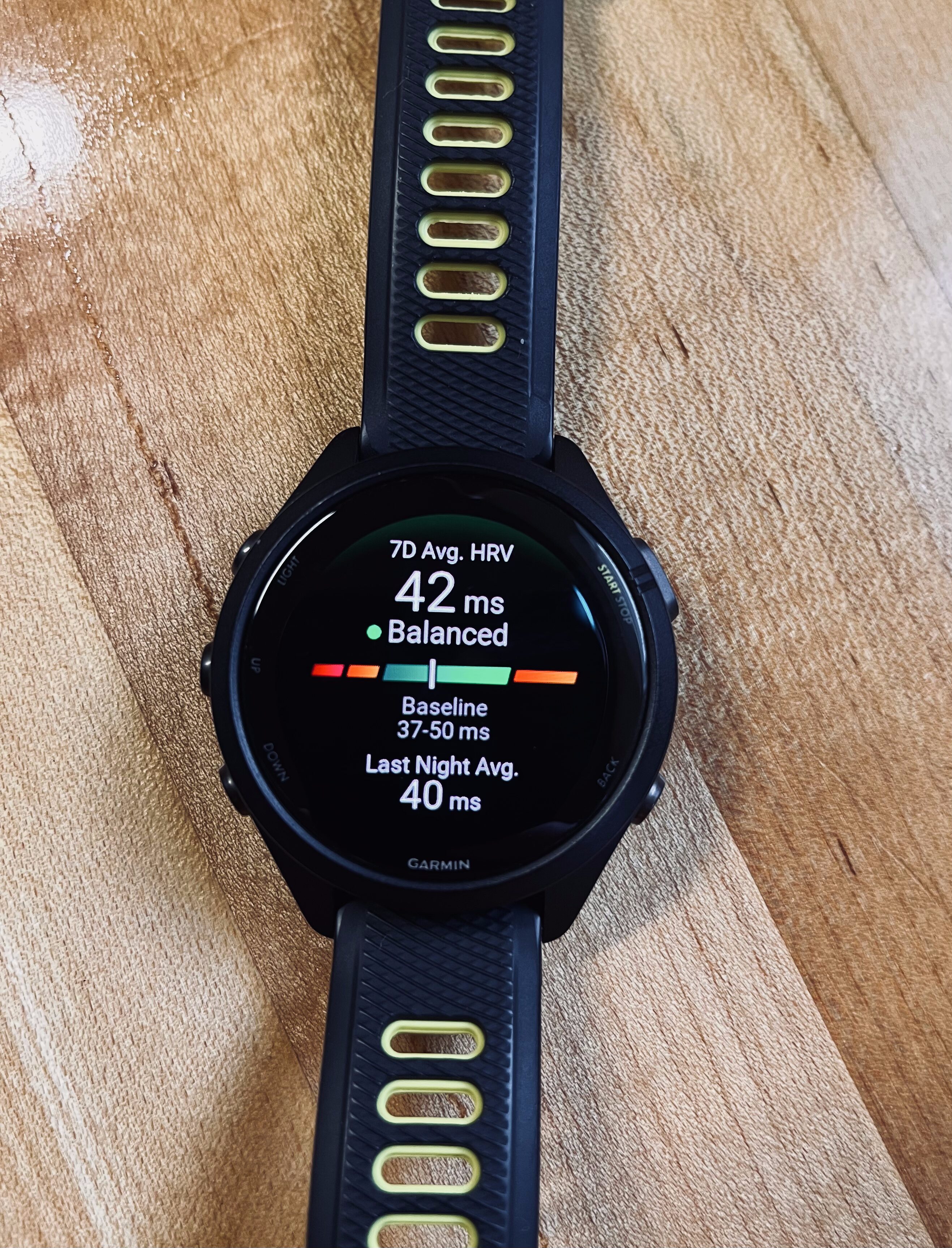
When I started Ironman training, I was already a few weeks in when I got the watch. Within a short time, I had recovery scores, training readiness, stress levels, sleep metrics — all the good stuff. One that stood out was HRV (heart rate variability). HRV measures your body’s balance between stress and recovery. A “balanced” score means you’re adapting well. An “unbalanced” one? Not so much.
Here’s where it got interesting.
For months, during steady training, my HRV stayed balanced. Then I went on vacation. I barely trained — just two light workouts in a week — and my HRV tanked. I didn’t feel rested; I felt off. Isn’t vacation supposed to do just the opposite? I’ve let my body rest from continual triathlon training. I thought that my recovery and stress would be better than ever. And that imbalance didn’t go away. Even when I got back, it lingered for two more weeks. My workouts felt sluggish. My sleep wasn’t as deep. I couldn’t seem to get back into rhythm.
It wasn’t until I pushed through some tired workouts — just got out there and did the work — that things started to shift. On the morning my Garmin finally said “balanced” again, I felt this deep sense of satisfaction. A small win, sure. But a big one mentally.
I had made the mistake of thinking rest alone would recharge me. But I wasn’t just missing recovery — I was missing my training. And not just physically, but mentally and emotionally too. The body and mind both suffer when one falls behind.
Don’t Wait to Return
The Stoic path isn’t about perfect balance. It’s about knowing what matters, and showing up for it — even when you don’t feel like it. Especially when you don’t feel like it.
If you’re in a slump right now, or coming off a break, or just feel “off” — don’t wait for the energy to magically return. Take a step. Go for the run. Do the uncomfortable task. Start the journal entry. Just one small act of alignment.
Stress will always be part of the game. But if you’re building yourself into someone rational, resilient, and honest — someone who doesn’t crumble at resistance — then stress becomes something else entirely.
It becomes the forge.
Leave a Reply